Showing posts with label politics. Show all posts

Friday, October 31, 2008

now read this: The Multi-Media Election

There's no better barometer for the changes afoot in media than looking at the technology that's driving this presidential election forward. Here's a very good overview of the massive shift in tech usage this election, from YouTube to social networks and all points in between:

But what’s of interest here is not how one media form compares to another — it’s how new media and old media are pushing and pulling both ways, vying for audience (power), learning from and reacting to the other.

Monday, October 27, 2008

now read this: Newspaper endorsements mapped

InfoChimps has a great visualization of the newspaper endorsements for the 2008 presidential election.

Friday, October 24, 2008

Googling the election results

An update to my primary-season look at the way Google search volume closely mirrors national polling data is up now on the Huffington Post. And it ain't good news for McCain

Friday, October 17, 2008

Googling the debate (again)

TechCrunch has a great look at the terms Googled during Tuesday's debate. Interesting that "Joe the plumber" was more of a steady burn instead of an individual spike, while Roe v. Wade went massive:

Tuesday, October 14, 2008

One step closer to nation-wide free wireless internet--but at the cost of speech itself?

The FCC has announced that they had finished a series of tests of a swatch of radio band that they're setting aside for a nation-wide, cost-free wireless internet service. Those tests concluded that that spectrum will not interfere with current mobile carriers signals (though ATT, T-Mobile, and all the rest are bitching already), which means that all systems are pretty much go for implementing this thing. Super geeky explanation here.

The idea behind it is that the government can use existing spectrum (spectrum opened up with the switchover to digital TV next year) to reach areas underserved by current internet carriers: rural America and underprivileged communities. In order to reach those places, the theory goes, you may as well open it up everywhere. And how.

If this plan goes through, and it doesn't get corrupted in the process (which, unfortunately, it probably will because that's how these things work), it means that in a couple years we will see an immediate and massive shift towards a ubiquitous hand-held, mobile internet. While that's the way things are moving anyway (the iPhone, Google's Android, and other bleeding-edge mobile devices are proving that), this will speed the adoption at a rate far faster than hundred-dollar service plans allow now.

Which means for publishers, the time is now to begin planning your mobile strategy in a way that is meaningful and useful. Because this will change everything. Again.

But--and there's always a but, isn't there--there's a problem:

Notably, both proposals stipulate that any free wireless offerings have mandatory content filters, preventing users from viewing any material that “would be harmful to teens and adolescents.”

Yep, we're right back to the Communications Decency Act of 96 again, as demonstrated by using "contemporary community standards" in order to define obscenity. It's a slippery slope that starts with pornographers and ends with medical information, novels, and all the other things that we, as a society, hold dear. It creates, once again, a tiered system of speech: one for the real world and one for the mobile web.

They give and they take away. A free national wireless internet is a goal that will help to transform our culture in ways that we can only begin to imagine. But at what price? Culture itself?

Monday, October 6, 2008

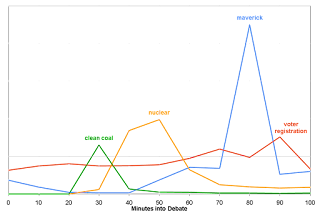
Googling the VP debates

The official Google blog has a fascinating look at people's searches during last Thursday's Vice Presidential debates. Wouldn't you know that "maverick" pops up higher than anything:

Monday, September 1, 2008

MySpace Muckraking

Yesterday, when rumors began to swirl that all may not be as it seems with GOP VP pick Sarah Palin's family, I said the first thing I'd do if I was investigating the story was to find the MySpace and Facebook pages of daughter Bristol's friends. While you can scrub your family's past to a certain degree, the social graph is too deep to clean completely. If there were secrets to be found, they'd be lurking in teenage exhibitionism. All it would take is someone to look.

Well, someone(s) did.

If you expect it to help clear things up, it only makes things more confusing. But it does show the power of an individual blogger to do an end-run around much larger news organizations and discover some hidden truths about a family that gets more complicated by the day.

Four years ago, that wouldn't have been possible. Four years ago, it wouldn't have even been thinkable.

But today, it's clear that a run for higher office holds any number of web 2.0 pitfalls--including your kid's boyfriends sister's MySpace page. And that you're facing not just oppositional researchers and well-funded news organizations, but also anyone who wants to ask why.

Saturday, May 17, 2008

mobile ubiquitousness is changing the landscape for polling

A terribly boring, but very interesting YouTube video is making the rounds--it's an interview with Jeff Jones of the Gallup polling organization, talking about their experiments this year with polling mobile-phone only households in their presidential polls. Before now, it's never been done--mobiles were invisible to pollsters. It's a small sample (they're trying it in just four states), but it's significant:

While the inclusion of cell phone only households makes little difference in the Clinton-McCain contest, it benefits Obama by a net four points: Without cell phone interviews, and weighted using Gallup's usual likely voter model, McCain would get 49% to Obama's 46% (clarification: this result combines six Gallup/USAToday surveys conducted so far during 2008). With the cell-phone interviews included, the result is Obama 48%, McCain 47%.

If you want to watch the whole video (trust me, you don't), here:

Thursday, May 15, 2008

The wisdom of crowds

Here are two national presidential primary polling graphs. Both show the same basic scale, and both tell the same basic story: A Clinton lead throughout 2007, followed by a sudden jump in Obama support in January, and a lead maintained by him from there on:


Simple, right? Various polling data usually reflects each other, in part because it attempts to choose a random sample of people to use as a predictor. But these two polls aren't equal. In fact, the one on the bottom isn't a poll at all: It's a graph of Google searches for "Obama" and "Clinton."

Fascinating, isn't it? They're so similar--they show the same ebb and flow in 2008, with a wide Obama margin in February, when he was winning all those states, and then a compression again once Ohio and Pennsylvania came in, followed finally by a widening gulf again once the North Carolina blowout and Indiana squeaker happened.

Yet one is reflective of expensive and extensive polling (it is, in fact, an average of numerous national polls)--a reflection of stated support for a candidate--and the other is simply a record of who searched for their names--positively, negatively, actively, or passively. And yet they mirror each other. So what's the point of dropping millions into polling then?

When people talk about "the wisdom of crowds" this is what they're talking about. Because here's nothing but crowdsourced data, yet it's a perfect reflector of the national attitude. If it holds up, it's bad news for John McCain.

Thursday, April 24, 2008

it's important to remember: what we do is still a threat

With so much depressing news about the slipping influence of journalism, it's important to realize that what we do is still threatening to many. Stephan Bevan's first-person report of being arrested and held in Zimbabwe for "practicing journalism" is a good reminder that what we do is still important:
I had been there for only an hour when there was an urgent knock on the door. It was one of the staff. "The police are here. You should leave - you can go through the gate in the garden." I grabbed my laptop and backpack and headed towards the garden. But I had taken only a few steps when, from behind me, someone barked: "Where are you going? Stay where you are."

Suddenly, there were police everywhere, some carrying guns. I was surrounded.

Bearak told me later that there were more than 40 police. One, Jasper Musademba, had threatened to shoot him if he left the hotel room. While they were busy with Bearak, I asked one of the staff to alert the British embassy. Meanwhile, across the city, the feared secret service, the CIO, were raiding the opposition Movement for Democratic Change's centre of operations. President Mugabe's regime was tightening its grip and we were like flies caught in its web.

Monday, February 25, 2008

dropping the bomb on social networking

That's a literal title folks: The department of defense has adopted social networking technologies in a field-tested system designed to allow for more networked information flow than normal in the armed forces, according to a report from Rough Type's Nicholas Carr.
By clicking on icons and lists, [patrol leaders] can see the locations of key buildings, like mosques, schools, and hospitals, and retrieve information such as location data on past attacks, geotagged photos of houses and other buildings (taken with cameras equipped with Global Positioning System technology), and photos of suspected insurgents and neighborhood leaders. They can even listen to civilian interviews and watch videos of past maneuvers. It is just the kind of information that soldiers need to learn about Iraq and its perils.

The above is actually a fantastic model for a web-based journalism site to adopt. Can you imagine the kind of robust networked reporting that could happen with something similar?

Sunday, February 10, 2008

User-generated innovation

One of the unusual characteristics of a caucus versus a traditional vote is that everyone who attended knows the outcome. Yet traditional media has rarely reported these outcomes, waiting instead for official
results.

That type of information embargo is impossible anymore, thanks to the ubiquity of user-generated content creators on the web.

Witness the information flow coming out of Maine today, with near-real time results being put up on a Google map:

http://maps.google.com/maps/ms?ie=UTF8&hl=en&om=0&msa=0&msid=108855644820400443340.000445d3794716293aa9b

It'll be interesting to compare these informal results to the real deal one they're announced. If they're even close, it'll be a major ground-shift on how this stuff can be reported.

Saturday, February 9, 2008

sometimes, local still truly does matter

In the shadow of Super Tuesday, it seems that the national media outlets have decided that coverage of the February 9th primaries aren't worth major attention. 

When The Bigs move away from a story is when you can truly see that local news does still matter--like the Omaha World Herald's coverage of today's caucuses which paints a picture of chaos and confusion that the national media isn't picking up on at all.

Sunday, December 16, 2007

"There is a chance that historians will examine this period in American history and wonder if journalism left the field."

The New York Times this week published a captivating essay that manages to hit on:

1) The layoffs at the Chicago Reader and how...

2) They have grave implications for the future of investigative reporting and how...

3) That's a bad thing for us as a democracy but how...

4) All is not lost.

Your milage may vary on that last point, especially when he trots out Rupert Murdoch as his proof, but the rest of it is pretty awesome and includes a nice hook into the continuing Chicago police torture cases and how the Reader's the only paper that truly cared--that is until they laid off the lead reporter on the story last week. A truly haunting line:

Google and Digg never made a phone call, never asked hard questions of public officials, never got an innocent man out of jail

Wednesday, November 21, 2007

What do you do when Al Qaeda understands the Internet better than the New York Times?

While the major media companies continue to wallow in the idea that Internet publishing can be a mass-audience game, a new study shows that Al Qaeda--yes, that Al Qaeda--fully understands the concept that Internet publishing is no longer about broadcasting, but instead narrowcasting. Take a page from the terrorists, folks, because that's the future of the industry (not the blowing-up part, but the different-audiences-want-different-things part, duh).

PS. Thanks to Paul M. Davis for the link!

Tuesday, October 16, 2007

Kiss the strength of the shield

Congress is currently kicking the tires on a shield law for journalists that offers a level of protection from prosecution at a federal level--something that's been absent until now. That it's going to be dead in the water due to a promised Bush veto makes a lot of the arguments for and against it moot (two second summation: it started decent and got watered down), but in the process of crafting the law, congress is defining what it means to be a journalist, a pracice that seems both feudal and incredibly dangerous. Why? Well let's take a look:
COVERED PERSON -- The term "covered person" means a person who regularly gathers, prepares, collects, photographs, records, writes, edits, reports, or publishes news or information that concerns local, national, or international events or other matters of public interest for dissemination to the public...

OK, so far so good. They've got the bases covered more or less, and it's nice to see publishers in there too. But...

...for a substantial portion of the person's livelihood...

yikes

...or for substantial financial gain

Double yikes.

Tying journalism with the pay a person may get from their work seems like a tin-eared way of defining journalism at any level, let alone at the level of a federal shield law. Of course it's defined to cut out as many bloggers as possible, but the definition currently put forth also automatically cuts out protection of first-person narratives from whistleblowers, soldiers in the field, and other ground-level, primary-source (thus naturally amateur) material. And that's just skimming the surface! It cuts out most community newspapers and indie pubs who don't pay worth shit, any kind of volunteer-run publication, even freelancers who work other jobs (even if that other job is teaching about journalism). In other words, it cuts out many of the folks that help to create everything we know as journalism on a daily basis and it sets a legal precedent that could cause trouble for years to come.