I think, with no new updates since November, it's safe to say that MEGO is no longer an ongoing concern. What happened? A few things:
1) It's really depressing documenting the changes happening in journalism once they've reached the doorsteps of friends and colleagues. I know the industry has to embrace a lot of cold, hard reality, but it doesn't make it any less painful when jobs are lost and friends are set adrift.
2) I began writing about similar topics as MEGO for the Huffington Post and it's hard to serve two masters (especially when the number of people reading my work there is a thousand-fold over what it is here).
3) Much of the work that's the most fun--pointing to great pieces about the evolution of publishing and journalism--I'm doing much more efficiently on Twitter, and it's hard to add additional context here as well.
4) I can write about what I think journalism needs to embrace in order to reach its new golden age (really!), but it's more important to teach it, which is where much of my energy is going now. If you're at all interested in that level of granularity, you can follow along.
5) I have a lot of other interesting projects in the works and only a scant few hours in a day to dedicate to them all. Here's one of them, which is now ready (enough) to show off.
So that's where I'm at right now. That's not to say that MEGO may not be revived at some point in the future, but it's to say that at present it's best to find me other places. If all this is too much to follow, it's probably easiest to follow along at the Metablog, which collects all my various online activity (including a TON of journalism-related links).
Thanks so much for enthusiastically reading MEGO for all this time! See you around the web.
--Dan
Saturday, April 11, 2009
MEGO: What happened?


Saturday, November 1, 2008
Newspaper's fading election glory
A Pew Research study says that the internet has become the second-most cited source for election news after TV. Newspapers now hold the number three spot.
It's a pretty stark reminder, during this season of heightened interest in political news, just how far from their heyday newspapers have now fallen. No longer thought of as even the runner-up source of news, they're relegated to third place. I suppose it's better than the fate of radio, huh?
Friday, October 31, 2008
now read this: The Multi-Media Election
There's no better barometer for the changes afoot in media than looking at the technology that's driving this presidential election forward. Here's a very good overview of the massive shift in tech usage this election, from YouTube to social networks and all points in between:
But what’s of interest here is not how one media form compares to another — it’s how new media and old media are pushing and pulling both ways, vying for audience (power), learning from and reacting to the other.
Tuesday, October 28, 2008
now read this: a crackerjack analysis of circulation declines
The declines over the past two years are disproportionately large compared to the seven- and 12-year spans–again, despite growing population and, until recently, a healthy economy. In other words, the circulation slide is worsening. It's hard to see, especially with the economy in the tank, any sort of moderation of the downward trend. And that, in turn, chases off advertisers and leads to even more budget-cutting pain.
Monday, October 27, 2008
now read this: Newspaper endorsements mapped
InfoChimps has a great visualization of the newspaper endorsements for the 2008 presidential election.
How low can it go? Newspaper circulation drops again
Another day, another doomsday for print news. The latest circulation numbers are out and they're nasty.
But, there's still hope. Newspapers stay strong in Japan, thanks to a 27 year long decline in birth rates! The number of young people in Japan hasn't been lower since 1908. So there's the new model: Kill the youth. I'm sure it's been floated in some board meeting by now.
Friday, October 24, 2008
Googling the election results
An update to my primary-season look at the way Google search volume closely mirrors national polling data is up now on the Huffington Post. And it ain't good news for McCain
Thursday, October 23, 2008
now read this: the Chicago Reader's legacy of (Police) brutality finally gets its day in the sun ... after firing the writer
Although he would tell you he's only a "bit player," Conroy was probably as responsible as anyone for keeping the police torture issue in Chicago's consciousness during that time. He wrote about it and wrote about it, to the point that it probably wasn't good for his career
Monday, October 20, 2008
now read this: Nick Carr on the concentration of online readers
Yes, we still journey out to the far reaches of the still-expanding info-universe, but for most of us, most of the time, the World Wide Web has become a small and comfortable place. Indeed, statistics indicate that web traffic is becoming more concentrated at the largest sites, even as the overall number of sites continues to increase, and one recent study found that as people's use of the web increases, they become "more likely to concentrate most of their online activities on a small set of core, anchoring Websites."
"Now Read This" is a collection of short links to other excellent thinkers on online journalism.
1000 ways to say this, but Microsoft chose "automatic censorship"
A pretty jaw-dropping title for a patent filing by Microsoft that's designed to create automatic, real-time filtering of "offensive" language in audio.
It's easy to see how this can cause a stink. It makes you wonder if they're giving any thought into how things will play when they name stuff like this. "Filtering" would raise few eyebrows. But "Censorship"? Come on.
Dig deep enough into the patent and you can see that its intent isn't to create FCC 2.0, but instead to allow parents to monitor the language their kids hear through multiplayer video games:
Humans are remarkably adept at identifying words and phrases that are considered unacceptable. However, for certain types of broadcasts, it would be preferable to employ a more automated approach that avoids the need to pay for or provide a human censor to monitor the broadcast, while still enabling the audio data to be censored at an appropriate level. For example, in massive multiplayer games, it would be impractical to employ a human censor to monitor the multitude of voice chat sessions that might be occurring at one time.
Still, the potential for abuse of something like this--after all, it's going to draw from a generated list of words/phrases to block--is pretty daunting. As is the inherent limitation of censuring language without context: After all, a similar filter on a Christian site changed the text in Olympian Tyson Gay's name to "Tyson Homosexual."
Friday, October 17, 2008
Googling the debate (again)
TechCrunch has a great look at the terms Googled during Tuesday's debate. Interesting that "Joe the plumber" was more of a steady burn instead of an individual spike, while Roe v. Wade went massive: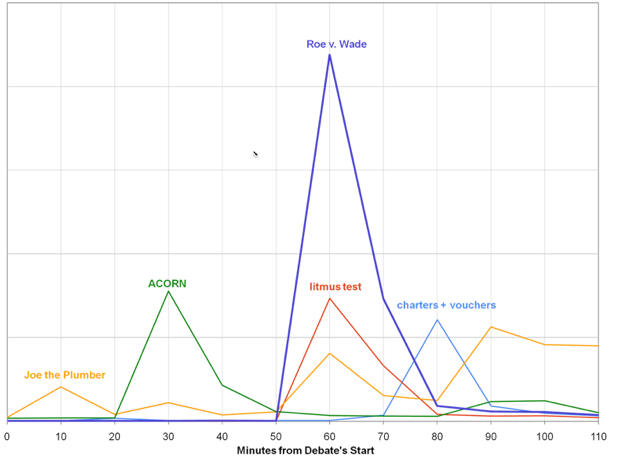
Thursday, October 16, 2008
Slipping Backwards: The loss of two journalists of color at the Chicago Sun-Times reflects the growing whitewashing of the news
Teresa Puente's bad day started when she learned that Deborah Douglas, her colleague on the Chicago Sun-Times' editorial board, and the last African-American voice on the board, had been laid off. Her day got worse when she found out that Douglas wasn't the only one to get the boot: Puente herself was out too.
With that, the five-person board was down to three, all of them white, purporting to speak for a city of almost three million, 60 percent of them people of color.
Why the cuts? Because the Sun-Times has found itself caught in the slow and painful drip-drip-drip of a newspaper on life support. It laid off 20% of its newsroom in January. It got kicked off the New York Stock Exchange in June because its stock value had fallen below a dollar (that value is now less than a dime). In the name of "innovation" it has redesigned itself so many times it's hard to recognize one month to the next. Lately, the largest item on the cover has been for a promotional sweepstakes. It's become one of those papers.
It's also been, historically, the exact kind of paper that spoke to and for the marginalized communities in the city (excluding its brief dalliance as a NewsCorp property). All the gumshoe reporter, "sticking up for the little guy" newspaper cliches apply: That was the Sun-Times. And as that little guy became not so little anymore--as the minority population in the city became the majority--the Sun-Times labored (though some would say "lumbered") to keep up.
In July 2007, editor Cheryl Reed proudly announced that the paper was "returning to our liberal, working-class roots, a position that pits us squarely opposite the Chicago Tribune--that Republican, George Bush-touting paper over on moneyed Michigan Avenue." Perhaps it's overwrought sentiment (after all, until it sold the land to Donald Trump, the Sun-Times was across the street), but it was worth saying.
But it didn't last long. The layoffs this year cut two positions from the board. Reed herself quit the Sun-Times shortly afterward, and the eight-person board had been slashed to five. And now five becomes three.
The carving up of newsrooms is not a new story--it's become so commonplace that it was written into the storyline of the last season of The Wire--but it is a big story. The blog Paper Cuts carefully tracks and maps the layoffs, buyouts, and firings that have been eating away at traditional journalism. The latest count? 11,719 jobs lost this year alone. When it happens to the auto industry, it's big news. But when it happens to the news itself, who reports it?
"I believe newspapers should be reflections of the communities we live in and write about," Puente told me earlier today. "But that's being lost in all the layoffs--there's no thought to preserving diversity."
Rick Attig, who won a Pulitzer for his editorials at the Portland Oregonian, echoes Puente's concerns: "The cutbacks in this industry are likely to follow those in most every other business, based on seniority. And you know who generally has the seniority on newspaper editorial boards."
If you don't, just look at the new makeup of the Sun-Times.
And of course, you can read that and say, "Well thank god for the internet," and you wouldn't be wrong. Online, opinions are like assholes: everyone's got one. But, says Attig, "I'd argue that there still is a place, an important place, for editorial boards that provide well-reported, well-considered local opinion writing. There are precious few institutions left that speak with a clear, strong and independent voice about the issues of the day."
In Chicago, a city that's 36% African American and 26% Latino, those issues are a reflection of the people who live there. Who's going to voice their issues now? Put a mirror up the Sun-Times, and it no longer reflects back the diversity of the city it took its name from.
For Puente, it's not about her job. She teaches journalism at a college in Chicago and the Sun-Times gig was part-time (full disclosure: I teach in the same department). But it is about "ensuring that diverse viewpoints are at the table." There's no time more important than right now to make sure that newspapers reflect the changing world around them, she says. "Look at where our nation is now--about to elect the first African-American President of the United States--and what that means for how far we've come as a society. But newspapers? They're slipping backwards."
Cross-posted with the Huffington Post
Wednesday, October 15, 2008
Facebook: over 10 billion served
Facebook just announced that they host over 10 billion photos now. Over 300,000 images are viewed every second.
Those numbers are simply staggering. It makes you realize just how much of a walled garden Facebook is, since they're so invisible to general users. I see maybe a few hundred photos on Facebook when I log in.
We'll give the always brilliant Nick Carr the final word:
I did a quick scan of the 10 billion photos and found that 3 billion of them included an image of beer, in keg, can, bottle, or pitcher form, 1.5 billion included an image of a bra, and 675 million included both beer and a bra.
Tuesday, October 14, 2008
More on the NY Times API
Read Write Web has a great breakdown of why the API is important, both for hackers, but also for journalism itself:
Reporting is no longer a scarce commodity. It's hard for these huge news organizations to do it faster, cheaper or even as well as a whole web of new media producers around the world. They may be among the top sources for original content still today, but considering the direction technology is moving in - that's not a safe bet for the future.
One thing that big media still does have a particularly good share of, though, is information processing resources and archival content. The Times' campaign contribution API is a good example of this. The newspaper is far better prepared to organize that raw information, and perhaps offer complimentary content, than any individual blogger or small news publisher.
The hacker-journalist revolution just got a major boost
The New York Times announces access to their data through the Beta release of the New York Times developer's network.
I've given the Times plenty of lumps in the past, but this is incredible. One of the great values of journalism is its vast power to collect and interpret data. The New York Times has just opened that up to anyone that wants access to it.
It's a limited release right now--only access to their movie reviews and their campaign finance data--but it demonstrates the power of opening up data for anyone to use.
And it kicks hacker-journalism into high gear.
One step closer to nation-wide free wireless internet--but at the cost of speech itself?
The FCC has announced that they had finished a series of tests of a swatch of radio band that they're setting aside for a nation-wide, cost-free wireless internet service. Those tests concluded that that spectrum will not interfere with current mobile carriers signals (though ATT, T-Mobile, and all the rest are bitching already), which means that all systems are pretty much go for implementing this thing. Super geeky explanation here.
The idea behind it is that the government can use existing spectrum (spectrum opened up with the switchover to digital TV next year) to reach areas underserved by current internet carriers: rural America and underprivileged communities. In order to reach those places, the theory goes, you may as well open it up everywhere. And how.
If this plan goes through, and it doesn't get corrupted in the process (which, unfortunately, it probably will because that's how these things work), it means that in a couple years we will see an immediate and massive shift towards a ubiquitous hand-held, mobile internet. While that's the way things are moving anyway (the iPhone, Google's Android, and other bleeding-edge mobile devices are proving that), this will speed the adoption at a rate far faster than hundred-dollar service plans allow now.
Which means for publishers, the time is now to begin planning your mobile strategy in a way that is meaningful and useful. Because this will change everything. Again.
But--and there's always a but, isn't there--there's a problem:
Notably, both proposals stipulate that any free wireless offerings have mandatory content filters, preventing users from viewing any material that “would be harmful to teens and adolescents.”
Yep, we're right back to the Communications Decency Act of 96 again, as demonstrated by using "contemporary community standards" in order to define obscenity. It's a slippery slope that starts with pornographers and ends with medical information, novels, and all the other things that we, as a society, hold dear. It creates, once again, a tiered system of speech: one for the real world and one for the mobile web.
They give and they take away. A free national wireless internet is a goal that will help to transform our culture in ways that we can only begin to imagine. But at what price? Culture itself?
Monday, October 13, 2008
site news: subtle layout change, subtitle change
A quick update tonight: I've made the main text column wider than the scant 410 pixels it was before. I think it's an easier read and more conducive to art than previously designed. Also, I've changed the subtitle of the blog from the older "writing on editing, publishing, and the future of journalism" to the simpler "thoughts on the future of journalism." Of course, that includes plenty of thoughts on the present and even a little on the past too. Thanks for reading!
The hits keep coming: Newspaper's online revenue down
Just in case 11,000+ news jobs disappearing in the last year didn't perk you up, how about the news that online ad sales are down on news sites, after 17 quarters of growth.
That drop isn't symptomatic of Internet advertising overall, which grew last quarter by 7.6 percent. The problem is, of course, that newspapers aren't competing against only other newspapers (which is already a massively different equation than they're used to, when they could have a near-monopoly over ads in their local market) but against the entire Internet. And while people are certainly looking at news sites, they're looking other places as well. And advertising follows eyeballs (or so the theory goes, anyway).
But in the Times story today, another issue is raised: Newspapers' thirst to sell every possible space on their page, forcing them to rely on small money ad networks to fill a lot of the open space on their sites. These networks, which pay out about $1 per thousand views, may be stealing advertisers from news sites themselves, says Steve Stup from the Washington Post Interactive:
“It’s still a situation where if advertisers even perceive they can reach your audience, they might be inclined to go with a network, and that’s a concern I have with networks."
It's high school economics class: supply and demand. If you're filling your pages with endless numbers of cut-rate ads, how do you expect to sell the good stuff at a premium? Here's another ad-dude:
“That high level of unsold inventory often creates a real challenge in terms of sustaining pricing or growing pricing,” said John Frelinghuysen. “In most media, especially in television, the traditional model has been that you drive sellout, and that gives you the ability to drive pricing over time.”
Here's another case of newspaper moneymen putting the cart before the horse: They see the space, not the value. To them, the Internet is an infinite page with which to fill with advertising. But value doesn't scale like that: the more that's available, the less it's worth.
Why does that sound familiar? Because, perhaps, it's the exact same equation that got newspapers into the predicament they find themselves in in the first place. If you never learn from your mistakes, how can you not repeat them?
Sunday, October 12, 2008
checking in on journalism job losses: It's worse than you think
With news this last week of more layoffs at papers as far flung as Spokane Washington and Honolulu Hawaii, I thought I'd check in with Erica Smith's brutal Papercuts site, which tallies and maps the losses in the newspaper industry.
Kinda wish I hadn't done it so early on a Sunday morning, because now my day is shot: 11,683 jobs gone this year.
You look at a number like that, and you're not even sure how to process it. That's twice the population of Wasilla, Alaska. That's a whole lot of voices silenced, and a whole lot of papers left without enough of a staff to truly produce the news their communities need.
One really does have to wonder how the traditional news industry is going to make it out alive. With the economy destroyed, that's only going to speed the destruction (hell, even blog-based news sites are getting into the act now).
It's easy to look at an individual paper and say "You did this to yourselves." But to look at a total like that--a staggering number, impossible to truly process--and you realize the immensity of the changes that are afoot.
Happy Sunday folks.
PS. Feel like getting even more depressed? This entry about the Spokane layoffs, written by the person spearheading their multimedia journalism strategy, is a sad and intimate look at the gutting of a new media newsroom.
Friday, October 10, 2008
Memeorandum Colors: geeking out a way to show blog bias
In this brave new world of political blogs, it's a given that they have a slant--but it's not always clear what that slant is, at least when clicking on a link. Couldn't there be some way of figuring that out? OK, figuring it out in a way that isn't overwhelmingly time-consuming? Couldn't it be done algorithmically?
Waxy.org hacker-journalist Andy Baio and Delicious founder Joshua Schachter decided that the answer to those questions was yes and went on to create Memorandum Colors, a Firefox plugin that works with the political aggregation site Memorandum to display the political leanings of the sites it links to. And they make it look so easy: 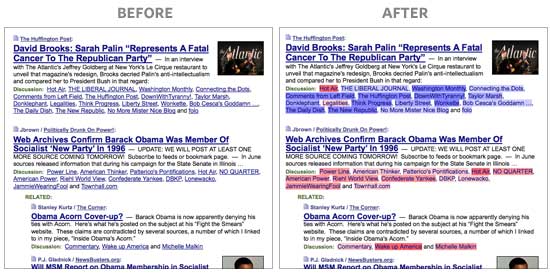
If that's not enough for you, how about their ultra-detailed tech explanation:
Armed with the spreadsheet of over 50,000 blogger-to-article relationships, we needed to somehow find correlations in the data. We used a method called Singular Value Decomposition (SVD), a method to break down complex data in matrices to its component parts.
If that made sense beyond a conceptual level, then keep reading the rest of their deep background--it devolves into matrixy goodness quickly.
The script itself is cool, and I'd love to know if it could be ported over to something like Google News or even Drudge (be interesting to see if his links were ever blue). But as a proof-of-concept, it's brilliant and as the understanding of how to manipulate data points spreads to journalists, it's exciting to see what they come up with.
